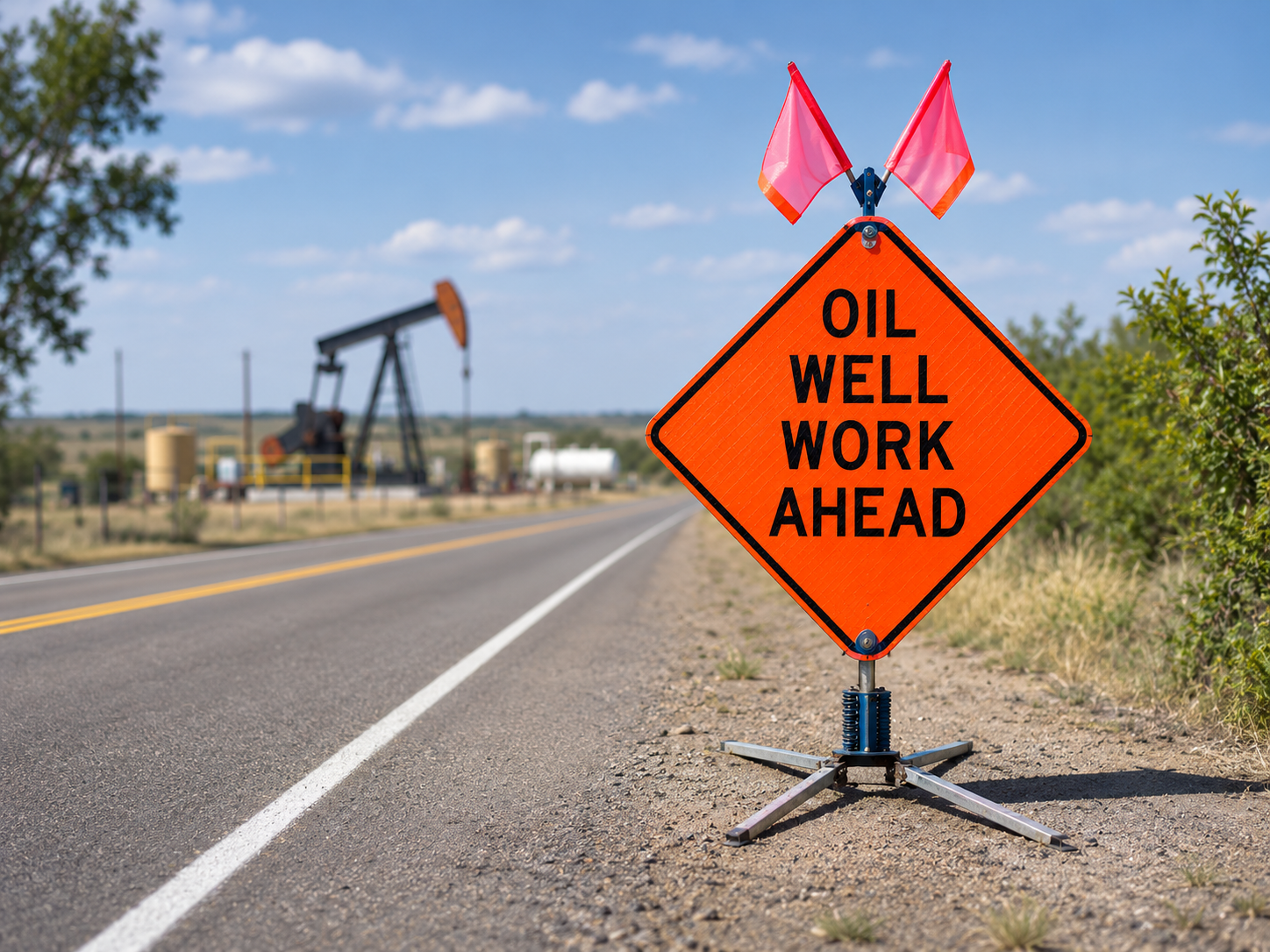
What a zero on a production report can mean — and some of the other things that can go wrong with a producing oil well.
This article was inspired by our well, the Dugas & LeBlanc #4, and its performance over January 2026 where the well produced zero barrels of oil, and new investors wondered why.
If you own an interest in an oil well, zero is generally not the number you are hoping to find on a monthly production report. It is also the kind of number that can look much worse if you do not know the story behind it. In the case of Dugas & LeBlanc #4, the well had produced before January and would produce again afterward. During that particular month, it was down for a workover.
That distinction is important. There is a meaningful difference between a well that can no longer produce and a well that is not producing right now.
It also gives us a convenient excuse to introduce a new installment of Oil & Gas Investing 101: Understanding Workovers. There will not be a quiz.
More importantly, though, Dugas & LeBlanc #4 gives us a good place to talk about a broader subject that does not get nearly as much attention as successful wells or big production numbers or new drilling prospects: what can actually go wrong with a producing oil well?
The short answer is: quite a bit. The more useful answer is that not everything that goes wrong means the well is finished.
The Material Complexities of an Oil Well.
For someone outside the oil business, it is easy to think about a producing oil well in very simple terms. There is oil underground, somebody drilled a hole into it, and now the oil comes out.
It is, unfortunately, a tad more involved than that. A producing well is a system of equipment operating both above and below the surface. Depending on the type of well and its producing method, that system can include casing, tubing, rods, pumps, valves, electrical equipment, tanks, separators, flowlines and other equipment designed to move oil, natural gas and water from a reservoir thousands of feet underground to the surface.
Like any mechanical system, those components do not last forever. Pumps wear out. Rods can fail. Tubing can develop leaks or other problems. Sand, scale or paraffin can interfere with production. Electrical systems fail. Surface equipment needs repairs. Flowlines and pipelines can have problems of their own.
Any one of those issues can temporarily stop production even though the reservoir itself has not suddenly disappeared.
That matters because a monthly production report generally tells you what happened, but the production number by itself may not tell you why it happened. A zero could mean the well has reached the end of its economic life. It could also mean that the operator shut the well down for several weeks to replace a pump.
Well Under Maintenance
This is where the workover comes in.
A workover is a broad industry term for significant repair, maintenance or remedial work performed on an existing well. In some cases, the operator is responding to a specific mechanical problem. In others, the operator may be replacing worn equipment, cleaning material out of the wellbore or changing the way the well is being produced.
The work can range from relatively straightforward repairs to much more involved operations. Sometimes an operator may even use an existing wellbore to attempt production from a different underground interval. That begins moving into the world of recompletions, which we will save for another Oil & Gas Investing 101 article, but can of course be searched up in our glossary under InvestInOil.co>Learn>TheBasics>A-ZGlossary.
The important thing to understand about a workover is that it does not automatically mean the reservoir has failed. Sometimes the hydrocarbons are still there and the equipment needed to bring them to the surface simply needs attention.
That does not make a workover irrelevant to investors. Workovers cost money, and they carry risk of their own. A repair can become more expensive than originally anticipated. Additional problems can be discovered once the work begins. Production may return at a lower rate than it had before the repair, or the work may fail to accomplish what the operator hoped it would.
That is part of the reality of owning a producing asset. Existing production reduces some of the unknowns involved in a new drilling prospect, but it does not eliminate operational risk.
Production Does Not Move in a Straight Line
Mechanical problems are only one reason the numbers on a production report can change. Another is something much more fundamental: oil and gas wells normally decline over time.
A well might produce 250 barrels per day, then 225, then 200 and later 180. To someone seeing those numbers for the first time, that progression can look like something is going wrong. In many cases, however, decline is an expected part of the life of the reservoir.
When a well first begins producing, reservoir pressure and other underground conditions can allow hydrocarbons to move toward the wellbore at relatively high rates. As oil and gas are removed from the reservoir, those conditions change. Production generally changes with them.
The question, then, is not simply whether a well is declining. The more useful question is whether it is declining approximately the way it was expected to decline.
That is one of the reasons engineers spend so much time studying production history and decline curves. A gradual decline that behaves reasonably close to expectations is a very different situation from a well whose production suddenly collapses without an obvious explanation.
For an investor, the important lesson is that lower production does not necessarily mean a well has failed. It does, however, deserve context.
Back to Dugas & LeBlanc #4
All of which brings us back to that ugly zero on the January production report.
Dugas & LeBlanc #4 was down for a workover during January 2026 and reported no production for the month. If January were the only data point available, there would not be much positive to say about it.
However, the well returned to production, and by July 2026 Dugas & LeBlanc #4 produced 6,108 barrels of oil equivalent during the month. During the final week of July, the operator’s reports showed the well averaging approximately 189 barrels of oil per day along with 49 Mcf of natural gas per day.
How we mitigate risk, despite unexpected inconveniences
Real oil-well production rarely creates the smooth line people might imagine.
A well can produce 200 barrels per day, then 190, then 185. It might be shut down for several days because of a mechanical problem, come back online at 180 barrels per day and later undergo another repair that changes the production rate again.
Viewed one day or one month at a time, those fluctuations can look alarming. Viewed as part of a longer production history, they begin to tell a much more useful story.
How has the well performed over six months? Over a year? Over several years? How quickly has production declined? How often has the well experienced downtime? What has it cost to operate? When repairs were made, did production recover? Is the well behaving roughly as expected for the reservoir?
Those are the questions that turn a collection of production numbers into an evaluation of an actual asset. And we at Cruciform are dedicated to communicating and working through these situations with our investors.
And that is one of the reasons we like existing production as the foundation of the boutique projects we build at Cruciform.
We do not begin with producing assets because we believe producing wells are risk-free. They are not. We begin there because a producing asset gives us something that a brand-new drilling prospect cannot give us: a history.
The well already exists. Hydrocarbons have already been produced. There are production reports, revenue statements, operating expenses, decline trends, repair histories and operating results available to evaluate.
Some months will be better than others. Sometimes equipment will break. Sometimes production will decline. Occasionally there may be a big ugly zero sitting right in the middle of the spreadsheet.
None of that eliminates risk. In fact, history often shows you exactly where some of the risks are–and that’s the point!
When we evaluate an existing producing well, we are not relying entirely on what we hope an asset will do in the future. We have the opportunity to study what it has already done in the real world — including the parts that did not go perfectly.
A producing oil well is not a savings account, and it is not a bond. It is a physical asset operating underground, using mechanical equipment that periodically needs attention, while selling a commodity at a price its owners do not control.
Sometimes owning an oil well means watching oil come out of the ground.
Sometimes it means fixing the equipment that makes the oil come out of the ground.
And sometimes it means opening a monthly report, seeing a zero and knowing that the first question probably should not be, “Is the well dead?”
It should be:
“Why?”