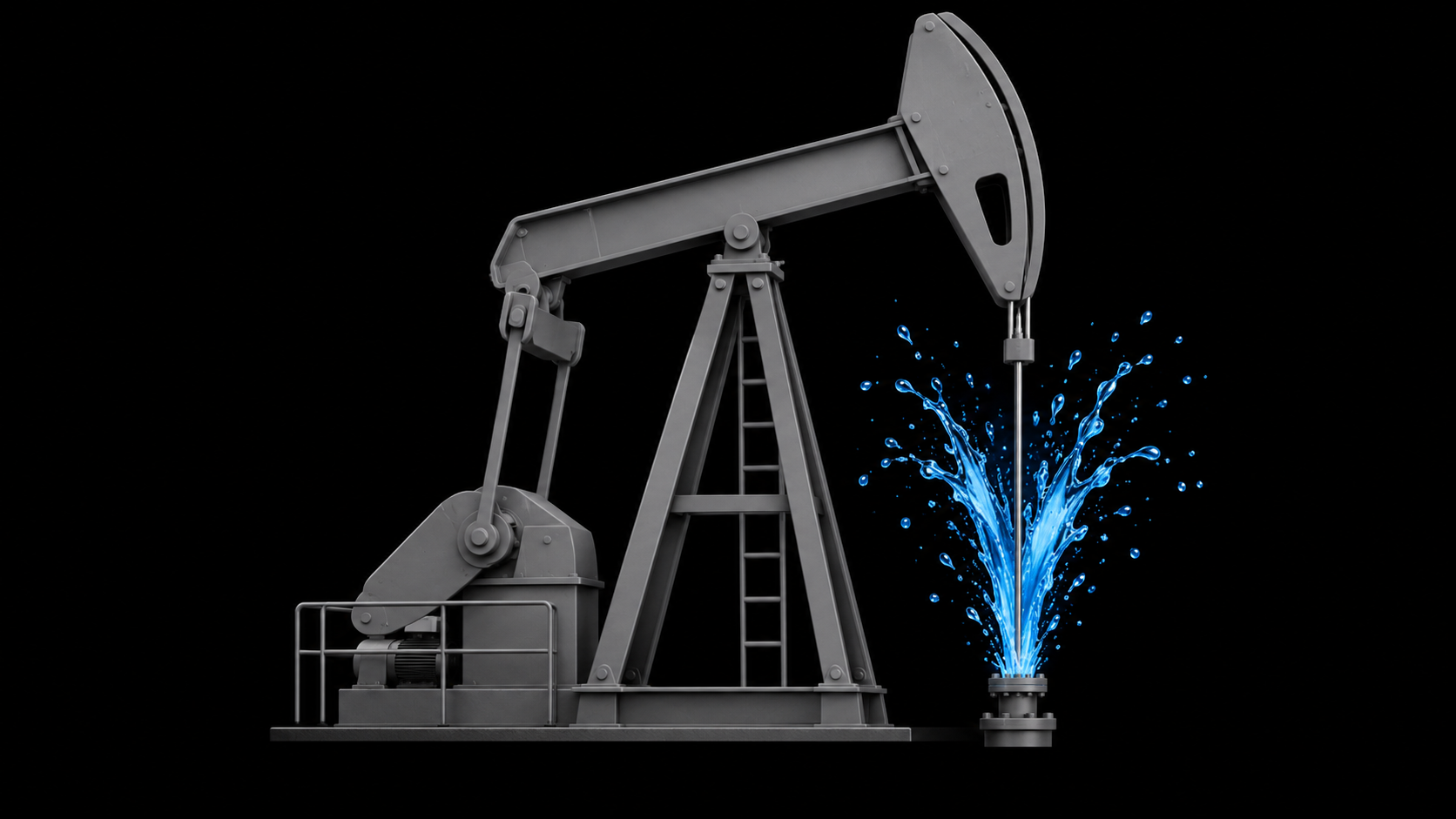
There is another number on a production report that has a tendency to get an investor’s attention. It isn’t necessarily a number they expected to see when they invested in an oil well, either.
Water.
Yes, water. As it turns out, oil wells don’t always produce just oil.
Depending on the reservoir, a producing well can bring some combination of oil, natural gas, and water to the surface. Sometimes there is very little water. Sometimes there is quite a bit of it. And those proportions can change considerably over the producing life of the well.
Water production is perfectly normal in many oil fields, and there are plenty of profitable wells that produce substantial amounts of it. However, increasing water production can eventually become an economic problem, particularly when the amount of oil being produced begins to decline.
Which brings us to another installment of Oil & Gas Investing 101: Understanding Water Production. Because, while we certainly appreciate water in our swimming pools, lakes, and morning showers, we’d generally prefer not to spend a fortune bringing it up from several thousand feet underground.
Oil and Water Have Been Neighbors for a Long Time

Deep underground, hydrocarbons don’t always occupy the reservoir by themselves. Oil, natural gas, and water can coexist within the same geological formation, occupying the pore spaces between grains of rock. Because water is generally denser than oil, it is frequently found beneath the oil-bearing portion of a reservoir.
As hydrocarbons are produced and reservoir pressures change, water can begin moving toward the producing interval. In some reservoirs, the natural movement of water actually helps maintain pressure and push oil toward the wellbore. This is known as a water drive, and it can be an important source of energy that contributes to a reservoir’s productive life.
Of course, the same water that helps move oil toward a producing well can eventually begin arriving at the surface alongside it.
Some wells begin producing water relatively early in their lives. Others can produce for years with very little water before the percentage begins increasing. There are also reservoirs where water production remains relatively stable throughout much of the well’s productive life.
The important consideration isn’t simply whether water is present, but how its production changes over time and what those changes may tell us about the reservoir.
Understanding Water Cut
One of the measurements operators use to evaluate water production is called water cut. It represents the percentage of the total liquid production that consists of water, rather than oil.
For example, a well producing 180 barrels of oil and 20 barrels of water per day has a water cut of approximately 10%. If that same well eventually produces 100 barrels of oil and 100 barrels of water, its water cut has increased to 50%.
Neither number, on its own, tells us whether the well is a good investment.
A well with a 50% water cut could still be an excellent producer, depending on how much oil it is making and the expenses associated with producing it. Conversely, a well with only a 10% water cut might be struggling economically if its total production has declined to just a few barrels per day.
This is why operators pay attention to both of the volumes being produced and the relationship between those volumes over time.
An increasing water cut may indicate changes in reservoir behavior, but it also introduces another consideration that eventually becomes just as important as the geology: the cost of producing the well.
Water Isn’t Free
When oil and water are produced together, the operator has to separate them at the surface. The oil can be transported to market and sold, while the produced water generally has to be treated, transported, or disposed of in an environmentally compliant manner.
In many producing fields, this involves injecting the water into a permitted saltwater disposal well, commonly referred to as an SWD. Depending on the infrastructure available, the water may be transported by truck or through a pipeline to the disposal facility.
There are costs associated with separating the fluids, operating pumps, maintaining equipment, treating water, and disposing of it. In some wells, increasing water volumes can also place additional demands on artificial-lift equipment, increase corrosion or scaling problems, and ultimately require more maintenance.
The economics can change considerably as the proportion of water increases, even if the total amount of fluid coming out of the ground remains relatively consistent.
Consider a well that initially produces 200 barrels of oil and 20 barrels of water per day. At that production rate, the revenue generated by the oil may comfortably support the operating expenses.
Several years later, that same well might produce 100 barrels of oil and 100 barrels of water. The total fluid production hasn’t changed dramatically, but the operator is now handling five times as much water while selling half as much oil.
Later still, the well might be producing 15 barrels of oil and 200 barrels of water per day.
At that point, the operator has a legitimate economic decision to make. The well may still contain recoverable oil, and the equipment may still be capable of bringing it to the surface, but the cost of recovering those remaining barrels could begin approaching, or even exceeding, the revenue they generate.
And that brings us to one of the most important concepts in evaluating mature producing properties.
The Economic Limit
Every producing well has an economic limit under a given set of operating conditions and commodity prices. This is the point where the revenue attributable to continued production is no longer sufficient to justify the costs required to operate the well.
Reaching that limit doesn’t necessarily mean the reservoir has run out of oil.
There may still be substantial hydrocarbons remaining underground. However, producing them may no longer be economically attractive using the existing equipment, infrastructure, and operating methods.
Water production can accelerate this process because it introduces expenses that don’t necessarily decline alongside oil production. In some cases, those expenses actually increase.
Commodity prices also play a role. A well that struggles to remain profitable at $50 oil may have a considerably different economic outlook at $85 oil. Likewise, a well with access to inexpensive water disposal might remain profitable much longer than an otherwise comparable well paying substantial trucking and disposal expenses.
This is one reason operating efficiency matters so much when evaluating mature producing assets.
An operator who can reduce lifting costs, improve water-handling efficiency, or eliminate unnecessary expenses may be able to extend the economic life of a well without increasing its oil production at all.
And sometimes, that can make a meaningful difference in the value of the remaining reserves.
Water as a geological resource
Beyond its impact on operating expenses, water production can also provide important clues about what is happening thousands of feet below the surface.
A gradual increase in water production may reflect the natural advancement of water through the reservoir as hydrocarbons are withdrawn. A sudden increase, on the other hand, might suggest water has found a more direct pathway into the wellbore.
Depending on the circumstances, that could involve water moving through a particularly permeable portion of the reservoir, a change in communication between producing zones, or even a mechanical issue with the well’s completion.
These distinctions matter because not every water-production problem has the same solution.
In some situations, an operator may be able to identify and isolate an interval responsible for excessive water production. In others, changes to artificial-lift equipment or production practices may help improve the relationship between oil recovery and water handling.
There are also circumstances where increasing water production is simply part of the reservoir’s natural depletion process, and the most practical response is to manage the costs as efficiently as possible.
Production engineers and geologists evaluate these possibilities by studying historical oil, gas, and water volumes alongside pressure data, well logs, completion information, and other available reservoir evidence.
It’s another reason a production report becomes much more valuable when viewed as part of a longer operating history rather than a snapshot of a single month.
The Bigger Picture: What Does It Cost to Produce a Barrel of Oil?
When evaluating a producing oil property, it’s natural to begin with its production rate. After all, the number of barrels being sold is fundamental to determining the revenue the property generates.
However, two wells producing the same amount of oil can have substantially different operating economics.
One might flow naturally, produce very little water, and benefit from existing field infrastructure. Another might require continuous artificial lift, extensive water handling, chemical treatments, and regular maintenance to achieve the same oil production.
Although the revenue may be comparable, the cash flow available to the working-interest owners could be very different.
This is particularly relevant when evaluating acquisitions of existing producing properties. Historical production is important, but so are operating statements, water-production trends, anticipated maintenance expenses, and the infrastructure available to handle produced fluids.
A well’s future economic performance depends not only on how much oil remains recoverable, but also on what it will cost to recover it.
This is where experienced operators can sometimes uncover opportunities that aren’t immediately apparent from the production curve alone. Improving the operating economics of an existing well can create value, even when there isn’t an opportunity to materially increase its oil production.
So, Then There Is Water.
Water production is simply another part of the business of producing oil and natural gas. It can help support reservoir pressure, provide clues about the behavior of a producing formation, and eventually become one of the principal factors determining a well’s economic life.
An increasing water cut deserves attention, but it shouldn’t automatically be interpreted as evidence that a well is nearing the end of its productive life.
There are wells producing substantial amounts of water that remain economically attractive for years. Others may reach their economic limits with relatively modest water production because of declining hydrocarbon volumes, expensive operating requirements, or unfavorable commodity prices.
As with so many aspects of oil and gas investing, the important thing is understanding the complete picture.
The production rate tells us how much oil and gas a well is bringing to the surface. The operating expenses tell us what it costs to bring those hydrocarbons to market. And the relationship between the two ultimately determines the economic performance of the investment.
Because at the end of the day, investors aren’t paid for the number of barrels that come out of the ground.
They’re paid from the value that remains after the costs of producing those barrels have been covered.